What's new
Pinball info

Register a free account today to become a member! Once signed in, you'll be able to participate on this site by adding your own topics and posts, as well as connect with other members through your own private inbox!

Recommendations for my first 3D Printer

@homhow are you finding the snapmaker u1? I have my eyd on one of these as my second printer to sit next to the p1s as I like the fact it has separate nozzles for colour prints. Is it as easy to use as the bambu software?
 
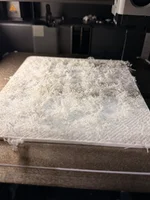
Hey knowledgable 3d printer folks. Anyone got any ideas on what’s happening here? Seems to start off ok, then goes pear shaped. (Bambu P1S is that’s useful. Standard PLA)
 

Attachments

  • IMG_0888.webp
    IMG_0888.webp
    86 KB · Views: 31
Possibly one for the Bambu guys in case there's something in the 'out of the box' slicer settings (Z offset, speed, temps) that may obviously need adjusting.......though unlikely these days with so many optimsed templates and PLA is the easiest filament to print with. A spaghetti print often arises from poor bed adhesion......so has the print shifted as can't make out from the pic? If so, clean bed with isopropyl and maybe try with some bed adhesive spray if that doesn't work. I assume from what you've written that you've tried to print it a couple of times already..........so if bed adhesion is good then try re-slicing in case there's a glitch in the G code. Trial and error is the order of the day I'm afraid..............good luck.
 
What type of filament is it ?
Id also check you have selected the right type in the software. (Though if it's bambu it's all set automatically using RFID tags)
Probably with posting a screenshot of your slicer settings.
Possibly moisture in the filament could cause it but generally wouldn't be just later layers
 
@homhow are you finding the snapmaker u1? I have my eyd on one of these as my second printer to sit next to the p1s as I like the fact it has separate nozzles for colour prints. Is it as easy to use as the bambu software?

The snapmaker software is based on orca - so feels pretty much the same as that. There were some niggles with connecting to the printer at launch but they seem to have resolved those.
Overall im over the moon with it - just a shame its only 4 colours. Speed difference and difference in waste is significant over the bambu but the quality is spot on.
Im generally just using the bambu for single colour prints since getting the snapmaker - but its good to have the option of 4 should the need arise (like my u1 is busy)
 
The snapmaker software is based on orca - so feels pretty much the same as that. There were some niggles with connecting to the printer at launch but they seem to have resolved those.
Overall im over the moon with it - just a shame its only 4 colours. Speed difference and difference in waste is significant over the bambu but the quality is spot on.
Im generally just using the bambu for single colour prints since getting the snapmaker - but its good to have the option of 4 should the need arise (like my u1 is busy)
Thanks for letting me know, I'm definitely considering one
 
Hey knowledgable 3d printer folks. Anyone got any ideas on what’s happening here? Seems to start off ok, then goes pear shaped. (Bambu P1S is that’s useful. Standard PLA)
Looks like one of those London cheesecakes i used to buy in Greggs years ago :)
 
What infill pattern are you using - I have read advice not to use grid as the crossing lines can cause problems (though it's never caused any issues for me)
 
Hey knowledgable 3d printer folks. Anyone got any ideas on what’s happening here? Seems to start off ok, then goes pear shaped. (Bambu P1S is that’s useful. Standard PLA)
What filament are you using? Is it the one supplied when you got the printer?

Adhesion looks fine from the picture, so that's not the problem. I would suspect that you have possibly used the support filament rather then PLA - it's a common error.

If you can provide some more details, such as what the model was, what filament, and a screenshot of the settings we should be able to sort it.
 
Fair shout if that's what Bambu advise; I'm a Prusa user and isopropyl is ok between prints and liquid detergent/water for a really deep clean.
Direct from the Bambu Wiki.

"The reason why we recommend detergent for cleaning the textured plate is due to its textured surface. Alcohol might just spread the oils on the print surface instead of removing it.
Detergent acts as a degreaser and using a sponge or scrubber to wash the plate will ensure the detergent reaches inside the textured surface to clean it and improve adhesion."


My cleaning regime is to use a plastic scrubbing brush and washing up liquid first.
Then rinse with boiling water from the kettle.
Dry with a clean teatowel.
Finally a wipe with 99.9% IPA.
At all times making sure to only handle the plate from the edges, to keep greasy fingers off the build surface.

For smooth build plates such as more focus should be on the IPA part.

I NEVER use glue sticks, hair spray or any other kind of adhesive on my plates at any time.
To remove scraps of filament that may have fallen from the nozzle during filament changes, I use a dry paintbrush to remove them, and any dust, rather than picking them off with my fingers.
 
Thanks Wayne J. Yes, I had a look at the Bambu site after the comment from Epotech left me wondering if there was something in how Bambu plates are made which makes them vulnerable to Isopropyl. And it seems this isn't the case. Instead detergent is a preference as alcohol 'might' be less effective as a cleaning agent.......depending on how you go about doing it. In contrast, Bambu clearly warn against the use of Acetone as it will damage their (textured PEI) plate. Isopropyl with a microfibre cloth works absolutely fine for me as a quick rub down between prints; I've very rarely had anything shift in hundreds of prints. The Bambu article specifically mentions textured PEI plates so I'm not sure if that's the 'default' plate or whether, like Prusa, Bambu also has smooth PEI plates.............ideal for PLA with Prusa. Anyway, I use both smooth and textured plates and clean them the same way.
 
Back
Top Bottom